
Vietnam: The Housemaid (2016)

Warning: this review contains spoilers. And by "spoilers" I mean I am going to give away the end of the film. It's more of a "ruiner" than a "spoiler". If you're likely to watch a spooky Vietnamese gothic horror then go and watch it now, otherwise read on.
I like unreliable narrators. It means you often have to go back and check just to see what's true, or at least it does if the writer has understood the potential of their own concept. You can get away with all sorts of nonsense with an unreliable narrator, and if done well it can completely change the way you see a film. There's an outstanding French film from 2002 called He Loves Me, He Loves Me Not. The first half of the film is told from one character's point of view, the second half is the same story from another character's viewpoint. It's a very clever film. Fight Club also features an unreliable narrator to great effect.
Alfred Hitchcock tried it once (in one of my favourite Hitchcock films) with Stage Fright, opening towards the end of the film, then using a flashback, before showing how we got to that point and then carrying on. Hitchcock was rather more of a trailblazer than he's credited with being now (he's now regarded as The Master of Suspense, which is fair, but he was also one of the key architects of cinema, a pioneer who invented some of the very grammar of film we see even today), so the flashback being related by an unreliable narrator who is literally lying to the audience should have been seen as a stroke of genius. But it was a little too advanced for 1950 and audiences were livid, accused Hitch of cheating, and turned their backs on it. It's a shame.
We're used to flashbacks showing us what really happened. The Housemaid opens with the discovery of a body by the titular heroine, who is then interviewed by the police and tells us her story.
We quickly forget that what we're watching is a flashback related by one of the characters within the film and, even more crucially, we forget that she's a suspect for a brutal murder. Nothing we're told should be something we accept without question, but the film is clever enough to play with audience expectations and to make the the most of existing traditions. Flashbacks are usually truthful (mostly, it must be said, because of the strength of the backlash faced by Hitchcock), so we assume that they all are.
They're not.
Linh is the Housemaid of the title, a young woman who come to Sa Cat, a French colonial house in Vietnam, looking for work. She's made a maid. The house, we're told, is haunted. The estate is that of a rubber plantation and during colonial times (the exact time setting of the film isn't made clear, but looks to be the '50s, while colonial times seem to be twenty to thirty years earlier) the workers were treated brutally, some of them by the very household staff still working there now. People died, executed in the grounds. The owner, Captain Sebastien Laurent, lost his first wife and her vengeful ghost walks the property.
It's all very, very gothic. A heady blend of Gone With The Wind, Jane Eyre, and every other plantation melodrama you can think of. Linh falls for Captain Rochester Laurent, he reciprocates, they begin a relationship, ghosts roam the estate and bloody vengeance is enacted.
None of this is very good. There are a few moments where it verges on the genuinely spooky, but more often than not it's a little over the top and protracted. The Captain's estranged second wife Madelaine is pursued by the ghost of the first wife in a scene which starts off well but then goes on for too long, the hideous ghost slowly dragging itself along the ground to chase Madelaine. Madelaine runs too quickly so has to stop every three seconds to pause and look back so that the ghost can catch up. Madelaine then runs a bit more before pausing again. If it only happened briefly I might not have even noticed, but the whole sequence drags on forever. The initial dread invoked by the ghost is soon replaced by unintentional hilarity. What I didn't spot at that point is that what we're watching is a narrated account of something the narrator couldn't witness - she wasn't there. We've completely forgotten that by this point (which is indeed the point) so we don't question it, and that's the film's greatest strength; this is deliberately silly. It's there simply to scare the audience. Only the audience in this instance is actually the police. Linh is lying.
It happens again when the ghosts kill the wicked housekeeper who has been usurped by the new mistress (in every sense) Linh. The housekeeper is outside having been fired when angry ghouls climb from the ground and pursue her. It's a scene so way over the top that it's positively florid, although it's in keeping with the tone of everything else. It's so over the top it's stilly.
But it doesn't happen. We just don't know that yet. Similarly, when the handyman is killed by the ghost it's a ridiculous death, his dying scream being so protracted that it carries on even after his head has been lopped off. And I thought I was being so clever by making a mental note to mock this when writing the review, because I thought I could make a snide joke. I'd forgotten that this was a narrated flashback. I should have realised. This isn't what happened.
It was all Linh.
Linh is lying.
The entire film is exaggerated and histrionic because Linh is playing with all of us - the police and the viewers. It's a genuinely brilliant twist, because we really don't see it coming. Well, I didn't. Other viewers may have been sharper. I was simply under the impression that this was Hush... Hush... Sweet Jane Eyre, but it's nothing of the sort and I was completely taken in by Linh.
It was all her. She was the ghost. The flashbacks were lies and she was simply executing the people who had killed her parents during the dark days of the plantation. It's her who stabs the Captain to death. She exaggerated where necessary, possibly even invented the whole haunted thing, and the police buy it completely, let her go and assume something paranormal happened (one of the policemen is her brother who's been aiding her, so this isn't as far-fetched as I'm making it sound).
It's a genuinely impressive twist, and one that reframes the entire film. All of the things I was going to complain about in this review were actually cunningly calculated, and the more I think about it the cleverer the film becomes. It's actually quite, quite brilliant, and the overblown elements of it are entirely deliberate.
I'm suitably chastened (although it seems clear that the whole thing was done that way in order to provoke my exact reaction), and the narrative technique was inspired.
So if you've not seen it, go and watch it anyway. Who knows, if you're aware of the twist this might work really well as a deliberately meta comedy.
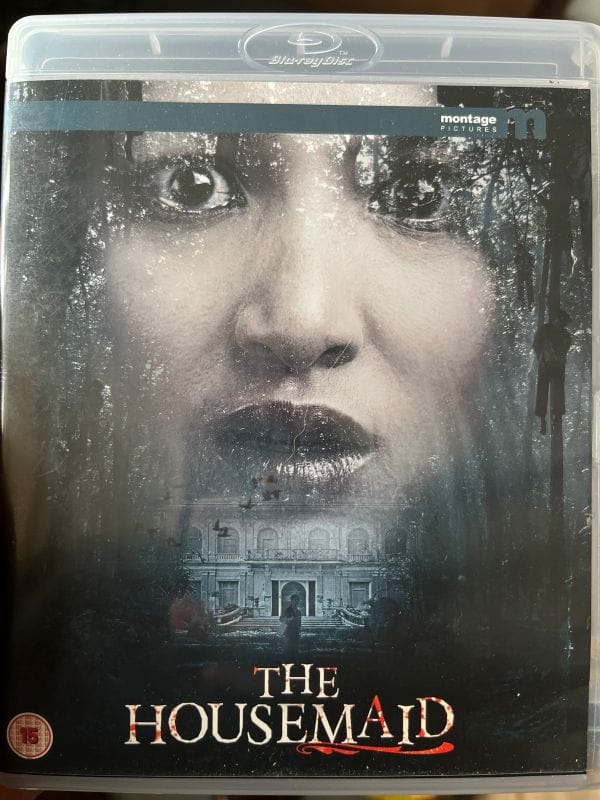
Disc: Blu-ray (Region B, UK)
Source: eBay
Availability: The UK BD is out of print but can be found on second-hand sites. It's a Eureka title, so tends to not be cheap. The US situation is exactly the same, because OOP Shout Factory titles sell for premium prices too. If you can find it, the film is available on streaming.