
Egypt: Clash (2016)

Sometimes people set a film in one location because the makers had a brilliant concept and wanted to make the most of it. (Exam; Phone Booth; ATM are all great examples of this.) The trouble is that they then can’t actually come up with much of a plot to go with it and the film becomes increasingly stupid as they find ways to keep the characters there.
Sometimes people set a film in one location because they’re working with a limited budget and want to maximise both their budget and their story possibilities. Both Coherence and Cube are outstanding examples of this.
Finally, there are films set in one location because they need to be. It’s not a stunt, it’s just that the characters happen to be there, and the location becomes a character of its own. The setting itself isn’t a gimmick, and nothing about it feels artificial. There are very, very few films that work this well (Lifeboat, Rope, 12 Angry Men and Pontypool are some of the more notable ones). Clash has now joined their number.
The entire film is set inside a police detention vehicle. This isn’t because the film is in any way low budget (there are wholescale riots and protests taking place outside the vehicle, and they’re clearly being recreated at scale because we can see glimpses of it through the windows) but because our audience identification figures are the characters locked up in the truck. They can’t see any more than we can, so we don’t have any advantage over them. We are, in effect, one of them. It’s an inspired touch and one that grounds the film in reality far more than one initially realises.
Clash is set during the riots/protests of early 2013, two years after the Egyptian Revolution. The president has just been ousted and there are clashes between the Muslim Brotherhood, his supporters, and those backing the military, which the film manages to explain with a few simple lines of text. This is the only concession to explaining for the audience, and it’s a smart move. This isn’t a film which needs us to know the background to the struggle, the ideology of the different parties or their aims. We just need to know that they exist. The actual politics of this aren’t relevant because this isn’t actually a film about politics – it’s a film about people. That the people are on opposing sides of a debate is the point – we never even know what the different views are. The point is that they have more in common than they have dividing them. Seen on those lines, this could actually be set anywhere there’s been human conflict: Ireland, Sudan, Syria or the Congo. The actual details of the dispute don’t matter – they may seem as though they do to the people involved, but, ultimately, they’re all just people.
It’s a message that Clash in no way simplifies or overstates (there’s nothing at all simplistic about this – the complexity of the emotions and levels of involvement is accurately depicted even if the nuances of the details aren’t), because nothing about the film is over simplistic. It’s an exceptionally balanced tightrope act, because at no point does the film even take sides – we see the characters, but we're not asked to choose a side, and the film doesn't endorse either side. I say "either side", but it's less clear cut than that - there are also the forces of law and order (both the police and the army) and also of different political movements and religions. There are even differences within the groups - some Muslim Brotherhood supporters are more extreme than others.
We open within the police van with two journalists being thrown inside, their equipment confiscated. The journalists are the voices of complete neutrality - they support neither side and are there only to observe. Soon more people are detained and the van begins to become crowded and claustrophobic. In clumsier hands each detainee may very well have been chosen to represent a specific viewpoint, but director Mohamed Diab (who also co-wrote with Khaled Diab - presumably his brother) wisely chooses to not pursue that angle. Instead these are simply people, not walking paradigms. The result is that they seem far, far more real, and we sympathise with all of them. We are aware, as the van fills, which protestors are members of Muslim Brotherhood, but beyond that the characters aren't given details like that. That's not to say they're not fleshed out - they are - but they're not defined by their politics. It's a smart move because it makes everyone within the truck all the more relatable, especially once the van comes under attack.
That's the problem with mobs; they soon become rampaging entities of their own, and the situation is no less different here. The truck comes under fire, initially from a sniper (who is also shooting at the police), but later from protestors too. No one is even sure which side the protestors are on - and the protestors don't care who is in the van. Violence breeds violence. It's an obvious message, but it's not spelled out obviously (I'm reminded of the moment at the end of the entertainingly silly disaster film Volcano in which one character - covered in ash - observes that now everyone looks the same, regardless of their skin colour underneath. It's a moment of absolute banality and it provoked bellows of laughter in the cinema when I saw it. It's true, yes, but it was spelled out in such an obnoxiously obvious and preachy way that the sincerity of it was completely lost. At no point does Clash make such an egregious move).
After various harrowing adventures (the detained captives are really put through the ringer, and as the audience is trapped with them throughout we can feel their fear and exhaustion) the van is finally toppled and beset with protestors trying to break in and slaughter them all. We have no idea which side the protestors represent (and, frankly, so little rationality is being shown by them that they may well not know either - they certainly don't care who they're trying to hurt) and that's the point - violence begets violence, brutality removes rationality. People suffer. Not groups, not ideologies, but individuals. Because it's always, ultimately, the individual who suffers.
It's a bleak and uncompromising ending, from a film which conveys an extremely complex set of circumstances without once miss-stepping. It's a powerful film, and a pointed one. Most importantly of all, it doesn't offer answers. This isn't a film designed to tell people what to think or how to behave; it's a film designed simply to make people consider the other side, to think of the people around them. "Mob violence is bad" is clearly an obvious conclusion - so the film doesn't make it. It simply lets us see what mob violence is and does. "Protests are dangerous" may be true, but the film doesn't say that. It simply says that this is what can happen. The audience aren't given solutions, or told what to think. The audience is simply left to consider that sometimes situations are more complex than we realise, but that at the heart of it are always just other people.
That's a powerful message, and it's one that is made extremely well by this very powerful drama. I thoroughly recommend it.
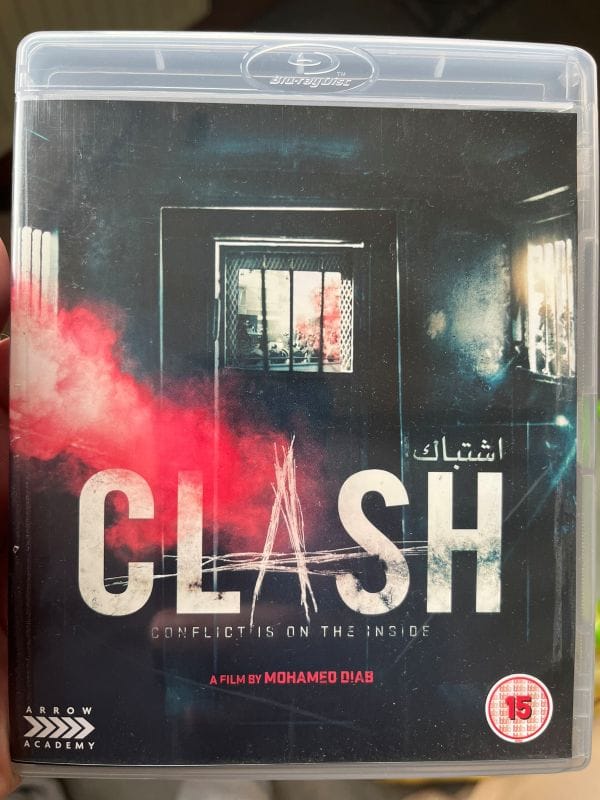
Disc: Blu-ray (Region B, UK)
Source: eBay
Availability: Still widely available. The UK has the only Blu-ray (and it's region-locked too), but other European countries do have DVDs, most of which lack English subtitles. People in the US are rather unlucky here. Demand a release from Arrow USA!