
United Arab Emirates: City of Life (2009)

I was frustrated by City of Life. Not because the film wasn't any good, quite the reverse; but it wasn't as good as it deserved to be.
The idea of having three parallel stories which run through the film before the three crash into one another unexpectedly (literally, in this case) is hardly new (the earliest one I can think of is DW Griffith’s Intolerance in 1916), and both Altman and Anderson have perfected this as a way of looking at every aspect of a topic from different viewpoints.
City of Life is intended as a celebration of the United Arab Emirates, and that’s one of the film’s three major problems. The UAE is made up of multiple Emirates – but you wouldn’t know it from this. Rather like saying you’re making a film about Great Britain, then setting it entirely in London, this ignores the other six Emirates in favour of Dubai. I get it – it’s easier to concentrate on one of them than all at once, but if I were in, say, Sharjah, I’d be quite irritated by this. And this ties in very much to the film’s second problem – it’s barely about the Emirates at all. It’s an exotic setting, yes, but there is absolutely nothing about this film that means it needs to be set in Dubai. This could be New York, Paris or another other city. We know nothing about the Emirates after watching it, nothing about the people, nothing about the culture. They're irrelevant in every meaningful way.
If this was described as a generic drama/thriller then it would be less of an issue, but all of the marketing suggests that this is a love letter to Dubai. Fair enough. But if this is a love letter I think I’d send my promise ring back.
The final problem is the three character studies themselves. Our first character is air hostess Natalia, who meets and falls for expatriate businessman Jason Flemyng. If you've never seen a film before you may well find it surprising when he turns out to be unfaithful and unkind. Most people, though, will have seen a film before.
The second story, taxi driver Basu's, is hampered by the fact that Basu is one of the least dynamic characters ever captured on film. Basu is insipid to an annoying degree, and - and this matters more than you'd expect - the audience don't respect him. The audience can cope with wet characters if we have some sympathy for them, but Basu is so unmemorable and uninteresting that his plight leaves us completely unmoved.
Finally there's Faisal, a young man living in his father's shadow and unhappy in his life. Now, there's a clear indication that in an earlier draft Faisal was gay but that everyone chickened out as the script was developed. Had Faisal actually been gay I'd be writing a very different review praising this as one of the most daring and important films ever made in the Middle East. But it's not that film. Instead of being in love with his best friend and unable to accept his sexuality Faisal just comes across as spoiled and weak. We don't know him, because we're never shown him. He's just...there. No wonder his father always seems faintly disapproving.
Eventually the three characters collide (literally) in an impressive multi-car pileup. It's all very Crash. Sadly that's the Paul Haggis Crash, not the Cronenberg one. Haggis's film was briefly popular when its simplistic and obvious depiction of race relations was mistaken for profundity before everyone saw the light and forgot about it. Simplistic and obvious is very much the relevant phrase here too.
The collision doesn't actually change anything particularly - the characters don't meet, get on and join together to defeat the forces of apathy. No, they just decide to do some stuff. And then they do it.
As resolutions go, it's not Memento.
The most annoying thing about all of this isn't how dull it is, it's how good the rest of the film is. This is a really well made film, and while none of the performances are ever going to win awards the cast aren't terrible (although the British actors should be ashamed by the quality of their performances - they clearly saw 'Dubai' in their agents' offices and just said "yes"). It's also really, really well directed. A lot of first-time directors either try to be too flashy and swiftly come undone, or they find themselves overwhelmed by the material. Ali F. Mostafa avoids all of those traps, so it's a shame that the material he was working with wasn't stronger.
Had other aspects of the film not been so strong this wouldn't have been as much of an issue (and I freely admit that following on from Capernaum was always going to be a difficult job for any other film - had I watched these in a different order I may well be more tolerant of this), but as it is this is a perfectly decent drama, it's just not particularly challenging or brave.
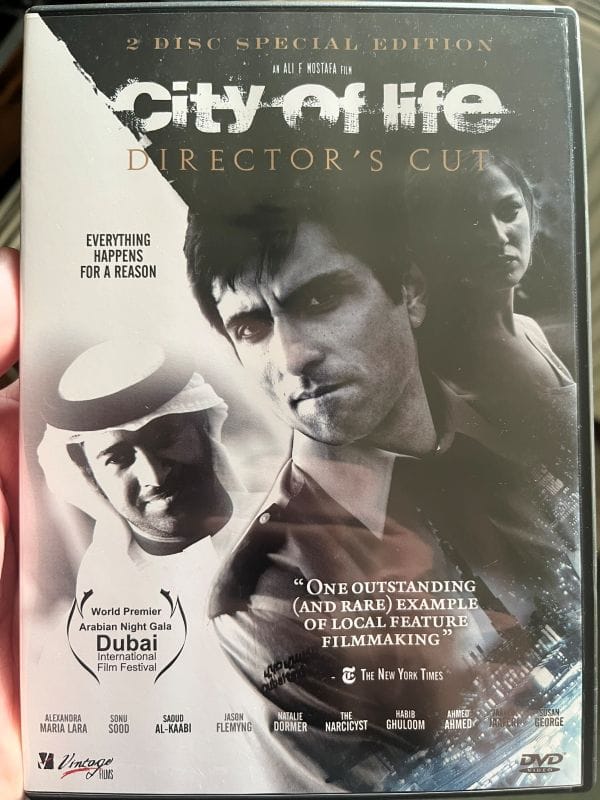
Disc: DVD (Region 2, UK)
Source: eBay
Availability: Out-of-print, but available if you look round. The Middle East also saw a release, and it's also easily found on various streaming services, if you're lucky enough to find it when they annoyingly rotate their films.