
Ukraine: The Tribe (2014)

I really struggled with this, and the reasons for it fascinate me.
The Tribe is a film from Ukraine about a group of students at a residential institute for the deaf. (They may also be unable to talk – the film is ambiguous on that point. It’s possible that they simply sign instead of speaking, which would make sense, or that they can’t speak, which would also make sense.)
The students can talk to one another and their teachers by using sign language. That sign language is never subtitled for the viewer. So just as the students can understand one another but not the wider world, so too is the wider world distanced from them here. We never know what they are saying, so all we have to understand them by are their actions. We can see them conversing but have no idea what they say. The fact that they’re saying it in Ukrainian is irrelevant – I can’t speak much more than five words of British Sign Language, let alone Ukrainian Sign Language. The distancing is deliberate and is perhaps the most successful way of showing the viewer how alienating it is to experience society differently. It’s a way of conveying a concept that is so successful it’s remarkable I’ve not seen it done before (although I have seen a similar effect achieved when a non-native speaker is confronted by a person speaking a foreign language and it isn’t subtitled for the viewer. We understand how the character feels because we’re just as baffled as they are, and uncertain of the tone and content of the words).
I am not deaf. Well, full disclosure; I’m deaf in one ear. I haven’t always been, and it’s something I’ve had to come to terms with. I have a hearing aid, but I don’t wear it because I found that when wearing it people became surprisingly patronising when they spoke to me. I was never sure if that was because they genuinely were, or if it was because I was so self-conscious of the hearing aid that I was imagining it. But being partially deaf (the other ear is fine) doesn’t even begin to give me insight into how isolating it must be to be completely deaf. An attempt by the director, then, to convey this is most welcome.
And I hated it. I struggled to engage with the film at all, because I struggled to follow what was happening. I’m not sure if that’s because I have some underlying prejudice against differently-abled people, if I can only engage with people like me, if I struggled because no attempt was made at introducing these people as individual characters in their own right, or because I rely too much on dialogue in order to follow a narrative, or if it’s a combination of all of them. There’s also the possibility that the life experiences of these youths are so far removed from mine that I struggled to relate to them. I accept that the experiences the teens have faced will be sufficiently alienating that they have turned to crimes which match their alienation. But as the film flatly refuses to explain the characters – or justify them – a great deal is left to the viewer. And I suspect that’s the point. It makes us question ourselves as much as it makes us question what we’re watching.
I have never stolen from strangers in the street. I have never forced my female friends into prostitution. I have never thoughtlessly assaulted people I considered my friends. My life is nothing like the lives these youngsters face, and that’s perhaps the part of the film I found the hardest to watch. It’s not that I lack sympathy (or at least not that I think I do) but that I found myself judging them, then constantly reminding myself that I can’t judge them because I’ve not lived their lives. I’m not struggling to get by. I’m not struggling to live within a society that seems entirely designed to exclude me. I think it may even be deliberate that such lives are presented to me in this way as a means to force the audience to consider prejudices they didn’t even know they held. Of course, I could be wrong and I could simply fail to have engaged with the film at all because I’m no longer a teenager! And certainly not one who fell for the wrong girl and accidentally got her pregnant.
What’s impressive about all of this, and the violence and the sex and the drugs, is that not once does it feel gratuitous or even glamorous. It just is. The stark existence these characters face is simply shown to us, without justification, context, or explanation. It just is. Deal with it.
I’ve always said that I wanted to be treated as an adult who needed to make up his own mind, and now that I have been it’s not an experience I enjoyed. These lives are too different to mine and the film gives too little in the way of help for the viewer. It’s alienating. The fact that I’m still thinking about it now, days later, suggests that this might not be a bad thing.
For the record, I think the alienation was genuinely intended, but I can’t say that with certainty; it’s possible I failed to engage with the film correctly (simply being in the wrong mood can affect one’s enjoyment of a film, and I did watch it during an unpleasant heatwave), but I don’t think so. I think the film was designed to provoke, and to do so in a way that wasn’t provocative, which is rare indeed. I may not have “liked” it, but I did admire it.
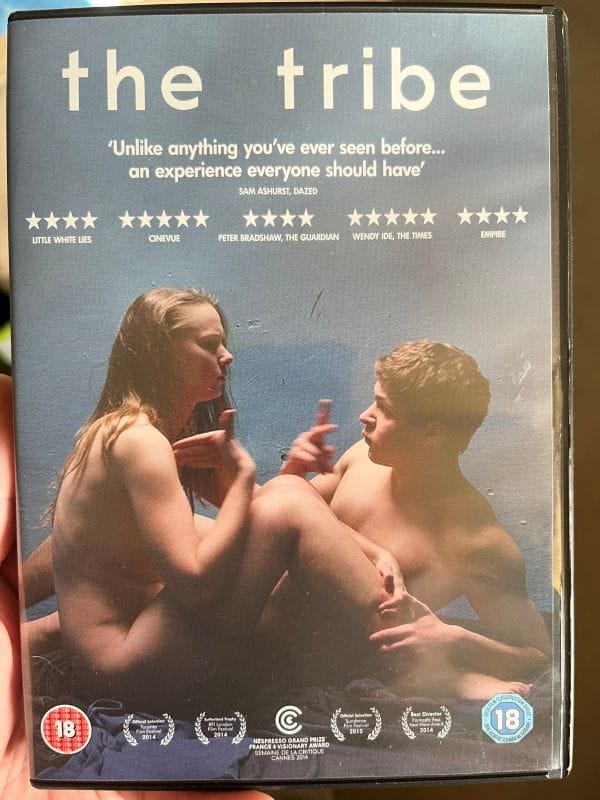
Disc: DVD (Region 2, UK)
Source: eBay
Availability: Still widely available; Blu-ray and DVD releases were originally released in the USA, UK and across Europe.