
Romania: The Whistlers (2019)

I struggled with The Whistlers, a Romanian film, and for reasons it’s taken me some time to understand.
Obviously most of the films watched for this blog will be in other languages. I expect that. And I don’t mind watching a film that’s subtitled, although my preference would be to actually speak the language. (I find dubbing more distracting than reading subtitles. Ten minutes into a subtitled film and you usually don’t notice you’re reading at all.)
I don’t mind subtitled thrillers either, so it’s not that.
No, the reason for my struggle is very much to do with an aspect of the film itself, and I don’t even know if other viewers have had the same difficulty.
Cristi, our anti-hero, is a corrupt policeman who is playing all sides off against one another, entirely for his own benefit. (His motivation is never entirely explained, which doesn’t help – or perhaps it is and I missed it.) His seniors are aware that he’s in the pay of the criminals, and think they’re using that to their advantage. The criminals are aware that Cristi is a policeman, so they’re definitely using that to their advantage, but again it’s not clear if they know he’s a double-agent. Or double-double-agent. It’s a confusing film.
It’s not told in order either (it’s one of those films), as aspects of the plot are laid before us so that the whole film makes complete sense. Ordinarily I wouldn’t have an issue with this and would even enjoy the puzzle aspect of seeing the different pieces fit together. The fact that it’s in a language I don’t speak means that one needs to read the subtitles slightly more closely, but that’s usually not an insurmountable issue.
Here there’s the whistling.
Cristi (and various others) opens the film on a trip to the Canary Islands where he’s been sent to learn a secret language. The Whistling language. Silbo Gomero has been spoken (well, whistled) for centuries. It’s a language used by the people of La Gomera, one of the Canaries, and is useful because it can be heard up to five kilometres away. The criminals want to use it as a clandestine way to communicate. They intend to break one of their members out of prison by having them sent to hospital. Using Silbo Gomero Cristi will comminicate which hospital and which ward.
It’s never actually clear why they want to do this when texting is a thing now. Whatsapp is encrypted securely enough that it would be untraceable by the authorities. And we’re probably not supposed to question why someone would be whistling so piercingly loudly that the whole of Bucharest will hear and start looking to see who is whistling so annoyingly.
So we have an unnecessarily complicated plot, told in an unnecessarily complicated fashion, in order to justify an unnecessarily complicated form of communication.
I had difficulty following all of this.
I can cope with subtitles, fractured narratives and even bizarrely contrived plots. I could even cope with a language which is explained in enough detail to allow most audience members to actually start speaking it. I can’t cope with all those things at once. It’s a mixture of both information overload and suspended disbelief crashing. It’s too much.
Don’t get me wrong, there’s a lot here to enjoy – the narrative is entertaining, the set-up is unusual enough that it holds the attention (and the whistling language is interesting enough in itself that I’d like to know a little more about it) and the plot is strong enough that it all holds together enough that the resolution is pleasing, but it’s simply too much for me to cope with all at once and I found it distanced me from the film. Instead of buying in to the artifice I was trying too hard to accept it. Instead of following Romanian with English subtitles I was trying to also understand a whistling language. It was more than I could manage.
It’s a shame, as, appearances aside, there’s an entertaining (if unsurprising) narrative to this, but the whistling itself is a ludicrous way of criminals conveying secret information (especially when everyone in the film is aware of what’s happening so can just look up how to whistle this on Wikipedia and save a lot of time), and there’s no actual need for the whistling other than to use a quirky language in an interesting way. The fact that it’s not credible is, sadly, the film’s undoing. It’s just unnecessary.
I’m all in favour of unnecessarily complex thrillers whose plots come together in pleasing ways, but I need to believe in them. I didn’t believe in this, partly because I was too busy trying to literally understand it, and partly because it’s just too silly.
Had I been Romanian, I think the removal of one layer would have been enough for me to accept the contrivance of the whistling, but when one is already overloaded and therefore forced to consider each layer it becomes clear that parts of this simply don’t work. The whistling makes no real sense.
It’s ironic that the very reason I’m watching this (as an outsider trying to view world cinema) is the very reason it doesn’t work (because I’m hyper-aware of the different elements). Or maybe the whistling was just too shrill for my hearing. Whatever it was, the film never quite cohered for me. The film was lost not in translation, but in the whistling.
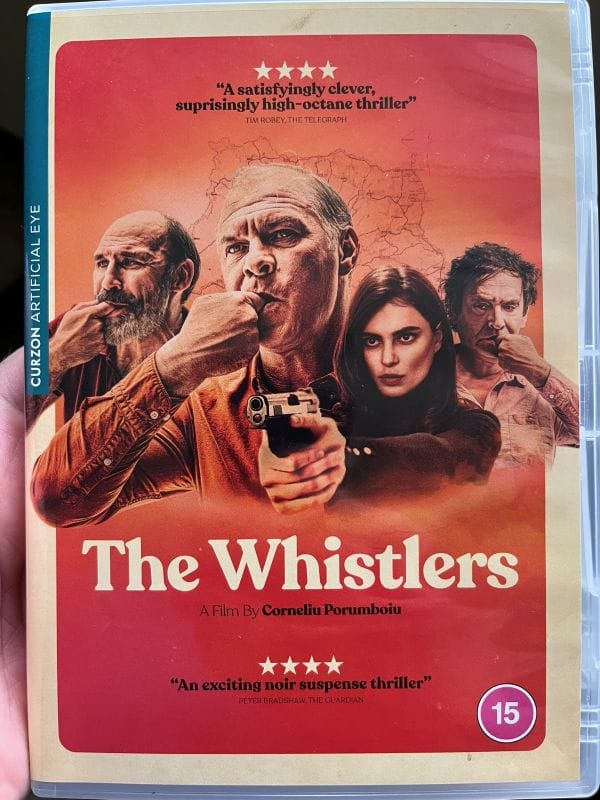
Disc: DVD (Region 2, UK)
Source: eBay
Availability: Widely available. DVDs and Blu-rays in both Region A/1 and B/2.