
North Korea: Pulgasari (1985)

The story behind Pulgasari is possibly far more interesting than the film itself, and surprisingly little known.
Popular South Korean actress Choi Eun-hee was abducted by North Korea in 1978. When her ex-husband, director Shin Sang-ok, started looking for her he too was kidnapped. Kim Jong Il, in a bid to improve the North Korean film industry, had orchestrated this, and for a time it worked. The pair made several films for the regime before fleeing during a film festival in Vienna (in 1986). I mention this because Shin’s final North Korean film, about a gigantic metal-eating golem, is only slightly more far-fetched than the kidnapping, which deserves to be better known and definitely deserves a film of its own.
The monster film is clearly a North Korean version of Godzilla, and whilst the moral complexity of reviewing a movie made under duress does make this questionable, with the lack of availability of any other North Korean film - and Pulgasari’s notoriety which guarantees it has a release - I’m left with few other options for the totalitarian dictatorship. And, frankly, when faced with a choice between a film in which starving workers gladly forego a meal in order to salute their glorious leader, or a film about a two-eyed, two-horned Korean pewter-and-people eater, the monster is going to win every time.
In all honesty, I'm not even a fan of the gaiju genre (I think that's the big monsters one. I might have mixed it up with something wildly inappropriate), but I do have a soft spot for big monsters in films, perhaps because I saw the terrible Godzilla cartoon series when I was young. Few of those films, though, take place in feudal Korea of the twelfth century, so the film does at least have the novelty factor of that in its favour. It's very much what I would expect Kurosawa to have turned out if he'd been encouraged by Toho to replace Shakespearean substitutes with gigantic reptiles.
The ruling king is a tyrant and the people are suffering. Too weak and lacking arms, they rely on their village blacksmith to aid them, but he's been thrown into prison. His son and daughter bring food to him, but rather than eat the food with his dying breath he fashions the meal into a model of a monster. This is the kind of film in which no one questions why someone would do that, nor how a few accidental drops of blood bring the golem to life. It's fantasy, and as in most fantastical stories it's expected that you just accept that these things happen. So the golem lives, becoming the Pulgasari of legend. The son and daughter discover that it eats metal, and the more it eats the bigger it gets. They naturally feed it (because it's surprisingly cute), and the creature does seem to have an insatiable appetite. Soon it's large enough that the initially fearful farmers realise they may have a secret weapon on their hands.
As revenge stories go, it's not all that unusual, save for the fact that the personification of vengeance is a great big Godzilla thing.
Soon Pulgasari is fighting the king's warriors, who come up with increasingly Road Runneresque ways of trying to defeat it. It's not an unentertaining story, and the effects are surprisingly good for a country that lacks any real film industry (then again, it is a Japanese and Chinese co-production). The smaller Pulgasari is well realised, the life-size one may be a man in a suit but it works, and when it becomes a towering giant the model work (and the ways in which the man in the suit is blended in with the humans) is more effective than I expected.
The plot too is rather more pleasing than I expected; the Kurosawa comment wasn't meanly meant, because (overgrown ogres aside) the setting is credibly realistic (at least to someone who knows absolutely nothing about the period), and the writing is given the freedom that fantasy usually allows - the tropes of propaganda are there, but this isn't a propaganda film. True, the oppressive tyrant is...hang on? Is that right? How bold! Okay, yes, the oppressive tyrant who is out to line his pockets and live a life of luxury at the expense of his subjects is defeated when the collective is too much for him. That's quite standard, really, as is the heroic act of self-sacrifice made at the end that restores order - the good of the community is greater than that of the individual. But these are hardly radical communist messages, and the film as a whole avoids them. It's not a propaganda piece in that sense, it's just an excuse to make a film about a very large monster going on a rampage. Had Shin Sang-ok and Choi Eun-hee not managed to escape (if you're wondering, they lived out the rest of their lives in freedom, although I can't imagine they ever escaped the trauma of their eight year ordeal) then the film would probably never have been withdrawn (Kim Jong Il wasn't happy) and we'd now be watching it in a pleasingly restored high definition.
Don't get me wrong - if you're not a fan of gaiju then it's not an undiscovered masterpiece; but is is a highly entertaining fantasy film with some decent effects. It won't change the world, but it will provide an hour and a half of entertainment.
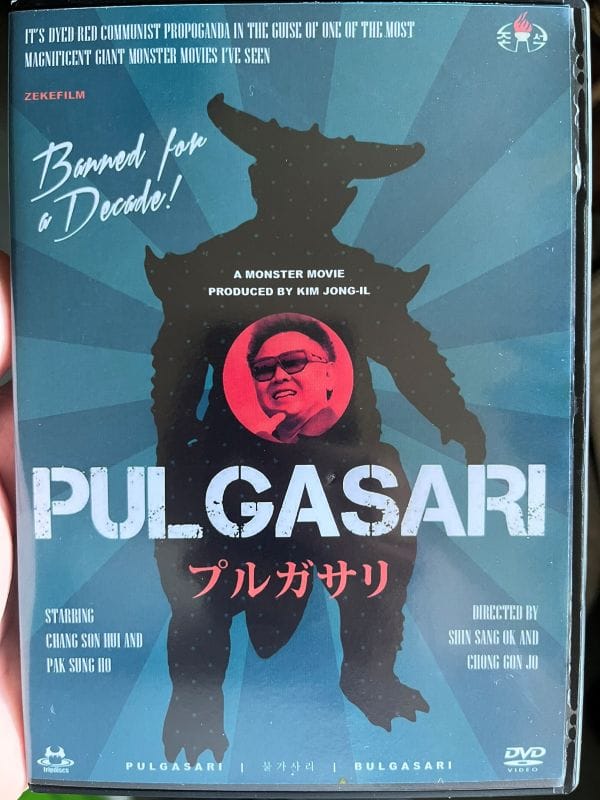
Disc: DVD (Region free, UK - in NTSC to ensure maximum saleability)
Source: eBay
Availability: This isn't an official release. It's not a bootleg either - we're in very grey territory here. You can't bootleg something which isn't covered by international copyright laws. This was the UK Tripdiscs release, and the print used is decent. Other regions have similar releases, but this really does deserve a nice HD version.