
Mauritania: Timbuktu (2014)

It’s haunting when a film is made so beautifully yet the subject matter is so harrowing. Timbuktu, my Mauritanian entry from 2014, concerns the jihadist takeover of the city by Islamic extremist group Ansar Dine in 2012. Timbuktu itself is in Mauritania’s neighbour Mali, but the truth is that this could be any city taken over by any extremist group. Islam as a religion is irrelevant here – extremism can take any form.
Timbuktu is located within the Saharan desert (as is much of Mauritania), and the film makes every opportunity to depict the brutal yet beautiful imagery of the landscape. The pace of the film is also deliberately slow (much as one imagines the pace of life in such an arid climate is), which creates a pleasing contrast with the actions of the jihadists. Events spiral out of control, but they do so at a slow pace, which makes them somehow seem even worse. It’s clear what is happening (to everyone watching – the residents of Timbuktu fail to see just how precarious their situation is. That’s because they’re reasonable people, and reasonable people always fail to anticipate the extreme actions of extremists. They’re called extremists for a reason!) but watching it happen slowly makes it seem far more real, and certainly far more disturbing.
I don’t live in a desert, or a Muslim country, but the film shows exactly how this kind of thing happens. (As an aside, my own local council recently changed political parties following the local elections in May. The new council have already refused to fly flags for Gay Pride in Pride Month. It’s a small act, but that’s how all of these things start. It’s the removal of acknowledgment for a frequently persecuted minority.) As a result, this is highly relatable.
The action unfolds through three parallel stories: there’s Kidane, a nomadic subsistence farmer and his family; the people of a local mosque; the extremists themselves. Timbuktu, a Muslim city, is known for its tolerant institution of Islam, so when the extremists begin by imposing stricter clothing regulations (no shorts; women to wear burkas, gloves and stockings) it’s not well received (not unreasonably, given the heat). Soon they have outlawed television, radio, football and music.
The film’s point is clear and well-made – the extremists are hypocrites. Despite outlawing football, they clearly follow the sport very carefully, discussing players and teams at a level of detail only real fans possess. They ban smoking, but the leader smokes. (At one point one of his subordinates even tells him that everyone knows he smokes in secret but none of them mind – they know they’re hypocrites and don’t care.) While recording a video extolling the virtues of their extreme interpretation of Islam, one of the younger ones admits he can’t deliver his lines with sufficient conviction because he doesn’t actually believe in them.
These are not extremists acting out of passion – they’re doing it because it’s something to do. It gives them power. They believe in what they’re doing on some level, but they also know it’s not right to take it as far as they do. They know they’re as flawed as all humans yet refuse to bend in the face of that. They show disrespect by visiting a mosque while wearing shoes (the Imam gently reprimands them – gently, because he seems to be the one person who realises how serious this is).
By the end of the film they’re whipping people for playing music, forcing young women into marriages they don’t want and stoning people to death for the most basic of infractions (in this instance, simply for having a romantic relationship). These are not the actions of rational people.
Our farmer Kidane suffers a real tragedy (his prize cow is killed for interfering with a fisherman’s nets) which sees a scuffle with the fisherman and his unfortunate death in the struggle. Naturally Kidane is brought before the ruling jihadists for their ruling.
We have seen that they are inflexible. We have seen that they do not respond to calm or logic. We know Kidane is doomed, but even so, the audience hopes for a different ending. There isn’t one. This proceeds with the remorseless calm pace that it has held throughout, which makes the tragedy seem even more harsh.
This is not a “nice” film. It is devastatingly beautiful, though. The harsh actions of the jihadists are matched by the harshly striking visuals of the desert, all unfolding at the same pace. The film is remorseless in that – and I use the word deliberately. The pace is not “slow” in the usual sense, although it’s certainly not rushed. It’s as remorseless as a moving glacier – mercilessly so. Events move forward. We can anticipate them, but we cannot prevent them. And that’s deliberate, clearly. Writer/director Abderrahmane Sissako took a true story from the headlines and used it to tell a cautionary tale about unchecked idolatry. (And I use that word deliberately too, because this rigid interpretation of Islam is so far removed from the true spirit of Islam that it’s idolatrous.) It’s a striking film, both in tone and visuals, and a rightly powerful one. It’s also one that deserves to be seen.
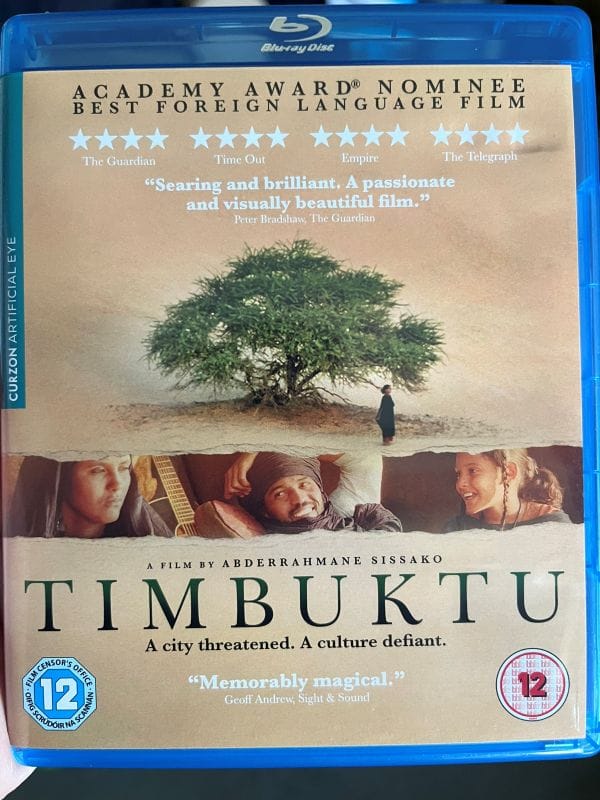
Disc: Blu-ray (Region B, UK)
Source: eBay
Availability: Still widely available; other Region B (French/Italian) releases exist; Kino Lorber have released on both DVD and BD in Region 1/A.