
Lebanon: Capernaum (2018)

I haven’t applied any particularly formula to how I acquire films. I’ve used AI to help narrow down the available titles, and then I’ve gone by genre where possible. For many places there’s been only one easily-purchased title. That means that I’m often watching the most famous film from a country (because that’s the one that’s most readily available), but wherever there’s been a choice I’ve tried to not opt for the obvious selection. It’s not that I’m being contrary, I’m just trying to keep this fresh. Not so much for you, the reader, but for me, the viewer. The more random and eclectic this is the more I think I’ll get out of it.
There is no consistency to what I get out of a film. If I expect a drama to be boring I’m sometimes wrong, or sometimes right. If a horror film sounds fun it sometimes is or it sometimes isn’t. I have learned that my preconceptions are random. They’re guesses. Take Capernaum, for instance. The cover said it was highly regarded but it looked a little serious. I love serious films, but only in the right mood. Because I’m watching these in acquisition order (by batch, anyway), I can’t always wait for the right mood to strike me, so I settled in to watch Capernaum expecting it to be worthy but dull.
I love being wrong.
It’s very rare to have to pause a film because I’m too moved by it and I’m finding it traumatic. I’ll pause to go to the loo or eat (obviously not at the same time), but not usually because a film is too good.
I found the humanity of Capernaum completely overwhelming, in a way I never expected.
Zain is a young boy (he doesn’t know how old he is – even his parents don’t. They didn’t keep a record of it. He looks to be around eleven or twelve) in court. The plot is initially confusing as we don’t know if he’s on trial (because he is acknowledged to be a criminal) or not. We don’t even know what his crime is. We do know that he’s being treated as an adult. Because, despite his age, Zain is practically an adult. He has an adult’s life, an adult’s responsibilities and an adult’s understanding of the world. Sadly, he also has a child’s sense of justice; he knows what’s right and wrong, and believes the world should be a fairer place.
Zain is one of the most remarkable characters I’ve seen since beginning this global journey. There was nothing about Zain that I did not find credible, and nothing that I couldn’t find relatable, despite coming from a background not at all similar. A Syrian refugee, Zain lives in Beirut with his parents, a family on the edges of society and the edges of existence. They eke out their life in the margins by committing petty crimes and selling drugs (which are only prescription pills ground down and repurposed). We initially see Zain’s parents through his own eyes (and as most of the film is told in flashback, our view is as biased as his – he’s not an unreliable narrator, but his view is limited). They are not good parents. When his beloved sister has her first period, he helps her conceal this because despite being only a year or two older than him they both know she’ll be married off by her parents. For money. They are really not good parents. They’re also a couple doing the very best they can for their family with extremely limited resources and little in the way of education. They’re not deliberately bad parents, and that’s the crucial thing. No one here is deliberately bad. It’s not that kind of film. There are no villains, no plots, just life and a society that has learned to ignore the people on the fringe. This isn’t unique to the Lebanon – this could be anywhere. It happens in every country around the world.
That’s not to say that this is in any way generic – it’s not, and this story could only be told in this way in this particular setting – simply that the themes it raises are universal. Broken societies break the people least equipped to survive them. Inequality isn’t inescapable, but it is firmly fixed in the favour of the privileged.
Zain knows this, and like all resourceful and clever people, he knows how to get by. He’s a survivor. Zain is both worldly (he knows how to survive) and naïve (he thinks things should be better).
His parents find out that Sahar has hit puberty and marry her off just as Zain fears. In disgust he leaves the family home. Being streetwise (Zain is completely at home in an environment most would find completely alien) Zain thinks he’ll be able to find work, but soon struggles. He eventually befriends a young Ethiopian woman, Rahil, who is an illegal immigrant with forged papers. Zain looks after her baby Yonas, bonding with him swiftly. He tells people that they are brothers. (Zain’s desire to find a loving family is subtle, but it’s repeated throughout the film.) When Rahil is arrested Zain is left to look after Yonas.
None of this is easy to watch. It’s not that anything unbearable is happening, simply that the unremitting grind of reality is continually working against Zain, and not once does it feel orchestrated. The style of filming is documentary-like, which makes this feel completely real. None of the events that unfold are hard to believe, and none of them are as bleak as they might be. This could be far worse, but that doesn’t lessen the horror of what we are seeing, nor make it feel less real. Piling on the tragedy would feel artificial, here the events seem completely credible – this doesn’t feel like a scripted film. Even when Zain discovers that his sister has died in childbirth (at thirteen, don’t forget), and his response is to take a knife and stab her husband, this doesn’t feel forced. (It’s this act of violence which is why Zain is in prison at the film’s opening.)
Zain stabbing the husband doesn’t feel remotely out of character for the child, and Zain is not a guileless cherub – he’s one of the most foul-mouthed children I’ve ever seen in a film (but his curses are never those of a child – he swears like an adult. It’s initially shocking coming from a child, but it’s a clever shorthand for showing a child navigating an adult world while also behaving like an adult). Zain is also a genuinely decent person – kind, thoughtful and optimistic, which makes his hardships all the harder to watch.
Zain Al Rafeea who plays Zain is himself a Syrian refugee who had lived an existence very much like Zain’s. (Not that this in any way lessens Al Rafeea’s performance – he’s still very much acting here, and his background shouldn’t in any way reduce the accolades he deserves. This is a far more nuanced and genuine performance than most adults give, let alone children, and he acts with a maturity decades beyond his years. It’s a performance that holds the film together [note to self – all of the films that I’ve really enjoyed have featured one or two such performances, and all of the films that I’ve not enjoyed but found watchable have also featured such performances. I’m perhaps more drawn to great acting than I realised]).
The ending is as happy as it could be without feeling artificial. After such a profoundly moving film it’s earned, but it’s not so ridiculously optimistic that it fails to convince. It’s an ending that’s absolutely needed by the viewer, though, because the humanity of this is almost suffocating in its intensity, and I was surprised by just how moved I was.
After a couple of other films I have looked up other films by the writer and/or director in order to make a mental note of things to look out for. This was Nadine Labaki’s third film. Before the credits had even finished I’d bought her first two. That’s how much of an impact this had on me, and how much I enjoyed it.
Whenever I’ve been enthusiastic in a review for this project I like to think that I have still been grounded in my praise without becoming effusive. I’ll make an exception for Capernaum – this is a incredible film and it deserves to be seen. It’s extremely moving, it’s beautifully played and it’s a film about people who never seem fictitious. I believe in these characters and their world. I cared about their lives. I was expecting worthy but dull, and instead I watched a masterpiece.
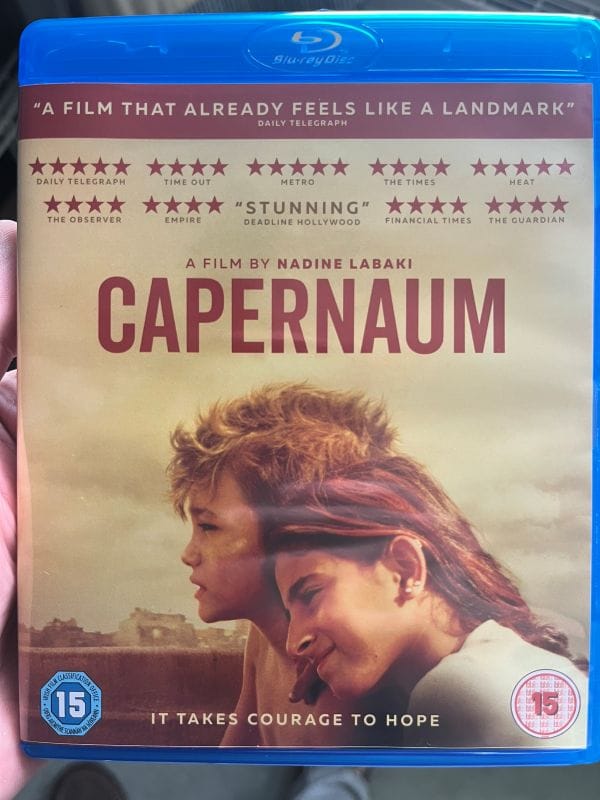
Disc: Blu-ray (Region B, UK)
Source: eBay
Availability: Still widely available; other Region B (Germany/French/Spain/Poland) releases exist; Sony Classics have released on both DVD and BD in Region 1/A.