
Jordan: Theeb (2014)

"They don't make films like this any more" is a rather pithy epithet thrown around all too easily (because obviously they still do make films like this or you wouldn't be able to make the comment in the first place), but in the case of Theeb you'd actually be able to make a convincing argument that it is resurrecting a genre that peaked in the '50s and has been steadily declining ever since; the adventure film. That's not what makes this interesting, though.
Obviously adventure films are still made, but I'm talking a very specific kind of adventure film - not the heroics of Indiana Jones (which is what we see today), but the very British stiff-upper-lip kind of adventure stories that are often described as Boy's Own in reference to the jingoistic British annual which presented tales of derring-do in an attempt to instil some traditional British values into the youth reading them. Those kinds of stories died out a long time ago (mainly because they present British imperial and colonial values as A Good Thing when clearly there's a lot more to discuss there than I'm willing to throw away in a casual blog entry). But not here. No, here those values are very much at their peak, because so is the British Empire.
This is set in the 1910s, during the Great War (as World War One was known before it had a sequel), so it's hardly surprising. We're in Lawrence of Arabia territory in Theeb (quite literally, in fact, because this is filmed where much of Lean's epic was, although in this instance they had to avoid tourists), right down to the presence of a British officer who wants to blow something up (he has a detonator which he guards with his life. It's not actually at all relevant to the plot - it's a true McGuffin, in the McPhail/Hitchcock sense - but it's also short-hand for an audience who are supposed to understand exactly why a British officer is there in this time, why there are raiders, revolters and Ottoman soldiers, and why all these groups are traipsing across the desert.
This is genre filmmaking for an audience who are supposed to understand what's happening - or at least that's how I'm choosing to read it, because so little is actually established by the dialogue. The background is irrelevant - it's just an excuse to get all these people into the middle of the desert so that young Theeb, a transient Bedouin, can grow up and learn hardship in the unforgiving desert. And that's where the film becomes truly interesting, because this isn't just an adventure story of the old-fashioned kind; no, this is also a Western. A Western set in the Middle East.
That alone gives the film an aura of mystique that it might otherwise lack. Despite the Western being a purely American invention, history has already shown us that other countries can have a go at them quite successfully without needing to film them in the Rio Grande - Sergio Leone did rather well in Italy, and Naji Abu Nowar does no less well here in Jordan.
And that's where this becomes really interesting; this is a film using the tropes of other genres (the British adventure story; the Western) but to discard the values they sometimes represent (there's no sense of British fair play here, nor of the sun never setting on the American dream) and simply use them as the backdrop to examine a very different genre: the coming-of-age story.
It's a fusion that could easily fail, because while there are complementary elements between the Western and the classic British adventure story (which were, to be fair, developed at pretty much the same time), you don't expect to find them in a film from the Middle East. This isn't Beau Geste retold, though - this is the setting of Beau Geste but with the background Bedouins as the main characters. This isn't the revenge plot of Eastwood's High Plains Drifter, this is High Plains Drifter from the point of view of the characters who weren't important enough to appear. This is a far more interesting twist to the adventure story than you expect; this is the underdog's story.
Theeb is a recently orphaned boy, being left in the care of his brothers. One of them is hired as a guide to an English captain; Theeb tags along, much to everyone's irritation. There's an ambush, bandits...sorry, raiders kill the party, Theeb suddenly finds himself alone, in the desert, with only one of the surviving raiders in a position to help. An unlikely alliance is struck which sees the two cross the desert while bonding with one another.
The complete and utter absence of sentimentality is what's particularly refreshing about this. Theeb is an orphan - that's a straightforward fact. He's not moping, he's not grieving, the desert life is one of brutal practicality. He's obviously not happy that his brother is killed, but survival is the most important aspect of the second act. It's the missing mawkishness, as well as the transposition of Western tropes into the desert of a foreign country, that makes this so much more than a simple adventure story - the deceptively simple plot hides an extremely complex emotional core, which is almost completely unsaid. The resolution, which is startling, is no less restrained, and seems perfectly fitting within the environs we've grown to understand. It's not a homely ending, nor an emotive one, but it's certainly a fitting one, and the performance by Jacir Eid as Theeb is the core of the film. He's never less than credible, perhaps because he is very much what he's playing - a child of the desert, curious about the strange adult world around him, but not in awe of it. It's a genuinely lovely piece of acting, and one which anchors the film throughout.
The cover blurb assures us that this is "a classic adventure film of the best kind", which rather undersells this; it's a far more ambitious and impressive film than that.
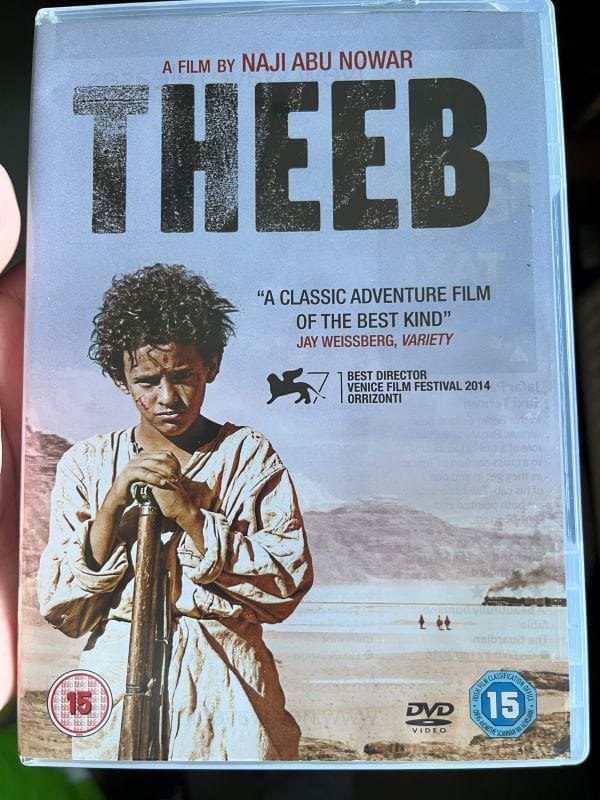
Disc: DVD (Region 2, UK)
Source: eBay
Availability: Still widely available; the USA has a region-free BD and a R1 DVD. Europe has only DVD editions. It's a shame - the cinematography for this deserves a 4K release. It's a stunningly beautiful film.