
Hungary: White God (2014)

The next three reviews were never planned as such (now that I've have a decent backlog of films for this project I'm watching them in acquisition order), but together they form a genuinely good overview of several distinct kinds of films. I've already written about why I prefer horror. (White God isn't strictly a horror film, although it is horror-adjacent.) There are three kinds of horror films: there are horror films which are clearly personal projects and intended to be taken seriously; there are films which are personal projects and intended for people to just have fun; there are films which are being made for contractual reasons - they're there just to make money (or to retain the rights to something that will be otherwise lost - most of the Hellraiser series, for instance). Luckily none of the next three fall in to the final category.
It’s possible that as a Briton I may have reacted differently to White God than most viewers would; Britons are famous for their love of dogs, and although we’re supposed to be a reserved and rather emotionally-restrained people, the one exception is where animals are concerned. We love dogs. We don’t want to see films in which animals suffer. I therefore found huge stretches of White God almost unbearable. Show me a film in which humans are tortured and I won’t bat an eyelid; show me a vulnerable dog trying to cross a busy road and I’ll have a mild panic attack.
I found White God a very hard film to watch; not because I wasn’t involved in the story, but more because I found the canine characters so relatable.
Lili is a young girl. Her mother is going to Australia for three months so arranges for Lili to stay with her father, a man she barely knows. Her father, Daniel, isn’t particularly thrilled at this, even less so when he learns Lili has a dog, Hagen. A recent change in the law means that mixed-breed dogs like Hagen now have to be registered and paid for.
As set ups go it’s not a particularly new one – clearly Lili and Daniel are going to struggle, they’re going to argue and they’re going to fall out before bonding over the dog. Probably. It’s a normal coming-of-age film.
Only it’s not.
Instead Daniel is going to dump Hagen miles away, Hagen is going to suffer abominably, and Hagen is going to stir all the strays of Budapest to rise up, Pierre Boulle-style. He’s also going to rip out the throat of every human that has wronged him.
This is not a normal coming-of-age film.
What’s particularly troubling, for me at least, is that at no point is any of this presented as a bad thing. We are firmly on the side of the dogs. It’s the revenge fantasy of Death Wish but on four legs. Yes, the people that have mistreated Hagen are wrong, but do they deserve to die? Is violence ever the answer to the question of violence? I don’t know, and the film doesn’t either because it doesn’t attempt to answer the question, instead it skirts it completely.
Perhaps I’m being unfair – the film’s already working on multiple levels so perhaps the question of vigilante vengeance is one too many. As it is we have the systemic marginalisation of minority groups (the mixed-breed dogs; Lila), power dynamics (human/animal; adult/child) and nature versus civilisation. (Absent parent Daniel even works in an abattoir certifying meat.) This is not a film which is content to simply have some dogs doing canine things. This is a film with a Message.
So this is one of the first group of horror films I mentioned earlier (and, yes, this isn't horror - it's dark fantasy at most, although it is extremely violent and there's a truly horrible scene of dogs being shot by the police) - it's a film made by someone for a reason, and it's something they clearly believe in wholeheartedly.
The film itself is clearly not operating in "our" reality - too many things happen that aren't realistic (although the film never actually depicts them in an unrealistic way), and it's clear that yes, this is dark fantasy and also film as metaphor. Perhaps had I been Hungarian I'd have found the message clearer (not that the film itself isn't clear, simply that I think it was aimed at the domestic audience, not the international audience, and I think the treatment of minorities/mixed-breed dogs was deliberately pitched to be understood by Hungarians (crucially, some of the dogs shot are pure-bred dogs too - you shouldn't side with the underdog. Or, rather, you should - because the dogs are in the right, ultimately). Are the key messages accessible to a wider audience? Yes, they are - the fact that I was able to identify them shows that, as was the fact that they had real meaning. This is a profoundly moving film.
Perhaps, watched as someone from a nation of dog lovers, I was already going to be on the side of the dogs, but even so this was a powerful and impressive film, and the cautiously optimistic ending (because you can never be too certain after a film as brutal as this one) offers a way forward, and a possible peace between human and animal.
The animals, by the way, are outstanding, and their performances never less than credible. Given that this features the largest canine cast ever assembled, that's no mean feat. The humans are strong too (Sándor Zsótér as Lili's father Daniel does extremely well to play the character as unsympathetic where many may have softened him, which actually makes him stronger and more understandable, while Zsófia Psotta conveys just the right amount of uncertainty as a teen on the cusp of adulthood), but it's the dogs that steal the film - and rightly so, because it's their film after all.
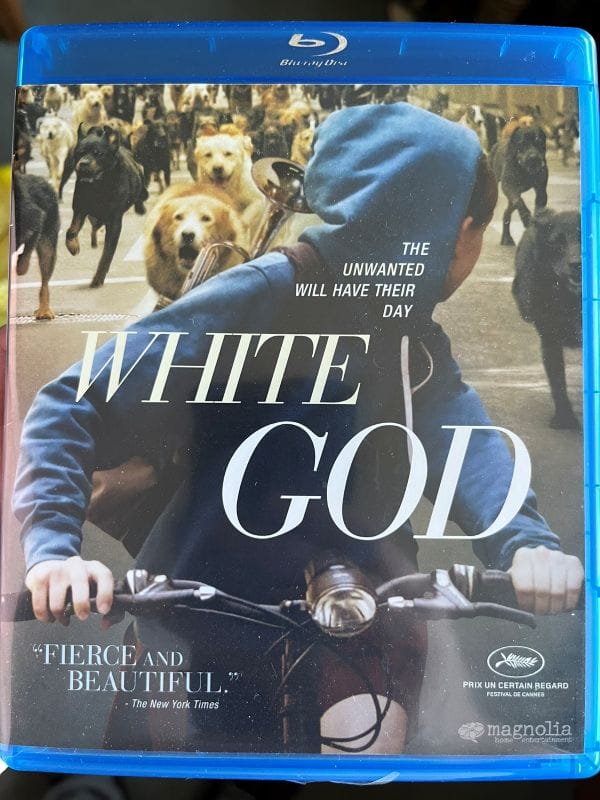
Disc: Blu-ray (Region A, USA)
Source: eBay
Availability: Still widely available; Region B (Germany/Spain) editions also exist; there's also a Region 2 DVD available in the UK.