
Georgia: And Then We Danced (2019)

Before watching And Then We Danced I knew only three things about Georgia: they take dance very seriously (the Georgian State Dancers are globally famous – the movement of the original Daleks was based on them because they were seen as so memorable); they’re a former Russian satellite; they’re not famous for their tolerance of homosexuals.
Now that I’ve watched And Then We Danced I know the same three things but also that, essentially, in most other respects their life is remarkably similar to that of every other European country.
The warmer European countries have a more laid back attitude to life; the colder ones less so, but in all other respects the culture of each country is very similar to that of their neighbours. Quite what other expectations I had I’m not sure (I’ve always said that people are similar worldwide), but thanks to decades of cultural conditioning I tend to think of most Central and Eastern European countries as being pretty much Ruritania. Hope has a great deal to answer for. (Those that aren’t Ruritania are obviously filled with either vampires or villagers with burning torches. Stoker and Hammer have a great deal to answer for too.)
Georgia is, though, very much like everywhere else. It’s not a country that gets a great deal of publicity and the people there simply get on with their daily lives, doing exactly what people do the world over – getting up, going to work, seeing friends and family. Merab, our protagonist, is a young man who works in a restaurant by night and dances by day. He’s the son of a dancer and is trying to keep the family tradition alive by securing a contract to represent Georgia at state level as a dancer, or something similar. You get the idea. The film doesn’t feel the need to go into the specifics because we get the gist of them (and, frankly, this seems to be a film aimed at the local audience anyway, despite the gloss and international worthiness of it).
Merab is gay, although he may not even be aware of that himself. (We’re never privy to his inner thoughts, and as he’s quite a taciturn youth we don’t ever really know what he’s thinking. It strikes me that I didn’t take to Merab as a character at all, perhaps because of his passive nature. I find that more intriguing than I did anything in the film. Do I only want to see characters who are proactive? What does that say about me? As a gay viewer I should be more sympathetic to a gay character, shouldn’t I? Or do I just dislike dancers?)
A new dancer joins the troupe, and Merab falls for him, even though they’re initially rivals. (Nothing about this is particularly surprising, which is perhaps again why I found it so hard to become invested in the characters. If they’re not going to surprise me, I lose interest. I’m not sure it’s that I have a short attention span, more that I’m simply not interested in characters who lack agency.) Merab has to face some awkward truths, and to learn to stand up for what he wants. I suspect had Merab not been gay the story would have played out in exactly the same way but both he and his new frenemy would have ended up falling out over a girl, before she broke both their hearts and went off with someone else, leading to their friendship being reconciled. It’s that kind of a film. Perhaps I wanted it to be more gay, for the ‘otherness’ of Merab to be more fully addressed. This is a coming of age film, and Merab’s sexuality isn’t necessarily given the focus I wanted.
The issue I have with all of this (aside from the predictability of it) is that Merab faces a genuinely impossible situation, one the film can’t fix. Georgia is a homophobic country. It’s not illegal to be gay, but it’s also not legal to beat up gay people either, yet that happens. A lot. It’s not Russian-levels of persecution (no one is disappearing) but the country is not at all gay-friendly. I understand that the film is part of a careful attempt to try to rectify that, and that you don’t win allies by shouting at them, but does that make this relatable? I don’t know. Is my issue simply me, the film, or the plot? If a film works on its own terms but doesn’t resonate with a viewer, whose issue is it? Or do we just accept that tastes vary and move on?
Many, many years ago (I think I was 10) my brother took me to see a ballet. He’d never seen one, he was stuck with looking after me for a week, and I’d never seen one either. So we went to the ballet. I was bored out of my mind. I understood it (they were using their bodies to express the drama of the music), but it did absolutely nothing at all for me. I can see why some people might like it, but I’m not one of those people. (It was Swan Lake, by the way. I love the score. I take no issue with the score. It’s the lack of words that causes me problems. I like to have people talking, not expressing their emotions through the movement of their legs and arms. My brother, incidentally, has never seen another ballet either. And they were people, not swans. Had it been performed by actual swans I may well have found it highly entertaining. But, as far as I know, no one has ever attempted Swan Lake with live swans, more’s the pity). We can therefore conclude that I am either something of a philistine or that I simply don’t like expressive dancing. I think it’s the latter.
What I’m trying to say is that I – a non-homophobic, non-dancing-engaged viewer – am not the target audience of the film, so my enjoyment of it – or lack thereof – is probably not surprising. Given my reaction to the Romeo and Julietesque Tanna, this should surprise none of us. I need to feel some kind of a connection with a film to really engage with it. And Then We Danced is not a bad film by any means (it’s extremely well played and made, and if you like dancing then there’s an awful lot of it), and I can see why some people would find it both moving and entertaining (and Merab comes through at the end and does indeed learn to stand up for himself, although it doesn’t seem to do him any favours), but the film’s simply not for me. Your mileage, as they say, may vary.
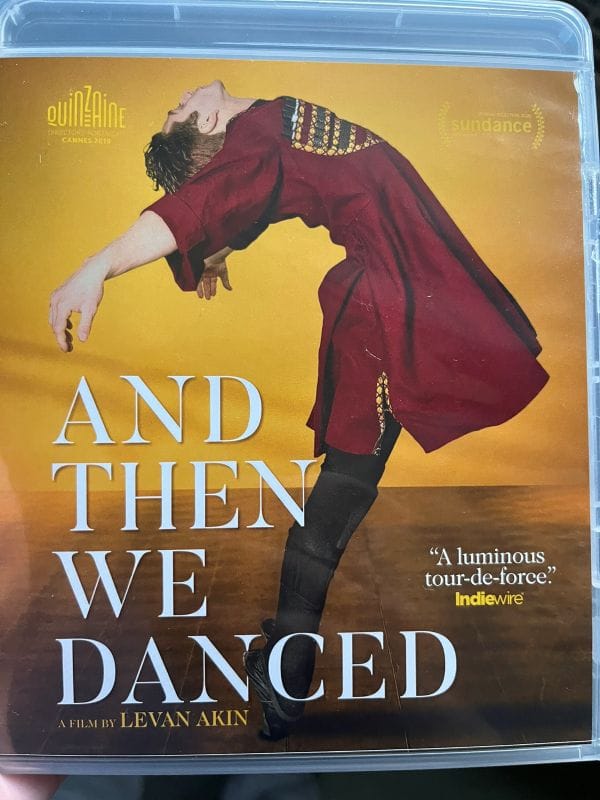
Disc: Blu-ray (Region A, USA)
Source: eBay
Availability: In print. DVDs and BDs in most regions.