
Ecuador: Cronicas (2004)

I try to watch these films with no foreknowledge. I may have an awareness of genre, and I can't help seeing the cover of each film, but generally I'm not aware of what the film is about. Sometimes that works for the film, sometimes against it. The issue there is all mine, though; just because a film doesn't go where I expect it to isn't necessarily a failure of the film itself.
Cronicas is such a film. I expected one thing, then I anticipated another, then finally I accepted what I had.
Cronicas opens with a journalist (John Leguizamo) covering a funeral for a child raped and murdered by a serial-killer. He’s about to secure an interview with the child’s twin brother when, in an unexpected and rapid series of events, the child is involved in a road accident and killed. Despite it being an accident the driver is pulled out of the car, beaten, and then doused in petrol and set alight.
As openings go, this isn’t gentle.
It did set me up expecting a high-octane thriller with an unusually grim plot, but that’s because I went in blind: this isn’t that film. Once the first act is over the film settles down into what I realised was going to be a cat-and-mouse psychological study. You see, the driver survives the ordeal, thanks mostly to Leguizamo, and while interviewing him in prison the driver reveals that he has met the serial killer and can help Leguizamo catch him if Leguizamo is willing to help get him out of prison. Leguizamo soon thinks the driver has rather more knowledge of the killer than he should have.
It’s not that film either.
There are elements of that, but this is a film about responsibility, the truth and the nature of journalism.
A BBC camera crew making a documentary for a David Attenborough series were once presented with a truly impossible moral question. The role of wildlife documentary makers has always been to observe – if they see a lion hunting a gazelle, they can’t warn the gazelle. Doing so would be to interfere in a way that moves them from documenting the action to being a part of the action. The ones given the moral dilemma were presented with a mother penguin and her chicks trapped in a pit. The mother could get out – not all of the chicks could. She had to leave them. The camera team decided to dig steps in to the ice to give the surviving chicks a chance (some had already frozen to death). The chicks escaped. They were praised for their actions – they involved themselves, but as indirectly as possible.
That’s what this film is really about. (Not literally, obviously.) What is Leguizamo’s role here? To document? To help the police? To investigate? To make a name for himself? He doesn’t know. He’s crossed several lines already (most documentary makers do) – he’s already been told where there’s a body, which he goes and digs up. He re-buries it, but at that point he’s now part of the story. Should he tip off the police? Should he investigate further?
There is no right answer here, and so the film continues its infuriating game of toying with the answers without giving them. We don’t know if the man in prison is the killer or not. Leguizamo may be the star – and it’s a good performance from an actor who’s spent a career giving good performances – but it’s Damián Alcázar who really impresses here. He has to play Vinicio as someone who could potentially be a child-killing rapist with more than 100 victims, or an innocent man looking for a way out of prison, and he has to do it without losing credibility or playing it as though he’s stringing the audience along. It’s a ridiculously tough line to give an actor and ask them to tread well, but Alcázar does and as a result he gives the film a level of legitimacy it would otherwise lack. We end the film still unsure if Vinicio is the killer.
Leguizamo’s character never knows either, and as he’s the protagonist and much of the film is seen from his point of view, he can’t know. It’s not that kind of film. I thought it was going to be, but it’s not the film’s fault that it doesn’t do what I expected it to, quite the opposite in fact. Had the film been about that I’d have been reviewing this as a competent and engaging but ultimately generic psychological thriller. It’s much more than that, and the film is rightly regarded as Ecuador’s most successful in years. The ambiguity is the point. And because this is ambiguous, we can be given no easy answers.
Alcázar, surely, knows if he’s guilty or not (you can’t play the part this well without having come to a decision, even if the script doesn’t make it clear), and equally clearly the rest of the cast have never been told. What could be annoying is instead the film’s greatest strength and prevents this from becoming a slightly exploitative and extremely sensationalist thriller (because the rape and murder of more than 100 children isn’t something to be taken lightly, and thankfully the film never makes that mistake).
There are no villains here – only questions. Could the police be more responsive? Of course. Could Leguizamo’s character have done more to help? Definitely. Did he have a moral duty to do so? I have no idea. Leguizamo has no idea either. He’s already realised how far he’s gone (he tries to stop his news piece from being shown, knowing that it will see Alcázar released from prison, but the very act that Alcázar is in prison for – the traffic accident – genuinely wasn’t his fault, so what is Leguizamo’s actual responsibility here?). But he’s a reporter – his job is to report. The police should be the ones investigating.
The film gives no answers, not because it wants to be vague but because it would be cheating if it gave answers. Even a scene intended for the audience alone (one confirming whether or not Alcázar is a killer, say) would mean that this is exploiting the subject rather than presenting a balanced view. This is not a thriller, despite having the elements of a thriller; it’s a drama that poses very specific and detailed questions, then leaves them entirely for the audience to answer.
Films rarely give the audience this level of responsibility. I like being treated as an adult. In the case of Cronicas, it makes me admire the film all the more.
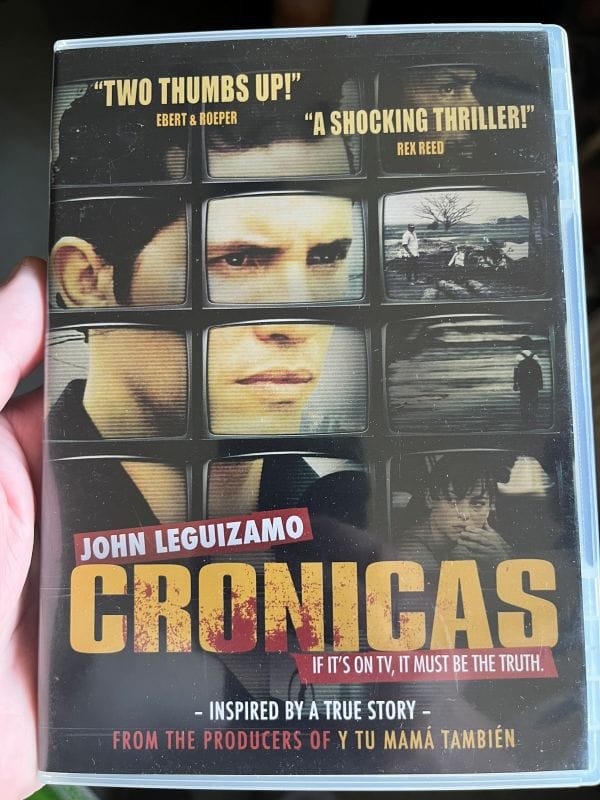
Disc: DVD (Region 1, USA)
Source: eBay
Availability: Long out of print; released on DVD in the USA, South America and in several European countries, copies are available on the second-hand market.